
To save money RVing is to understand that the lifestyle’s costs are more controllable than most new RV owners expect. The decisions made before and during a trip have a larger impact on the total cost. Fuel, campsite fees, maintenance, and food are the four largest expense categories for most RV travelers, and each of them responds to intentional strategy in ways that compound across a season of travel. The RV travelers who save money most effectively are those who understand where the money actually goes, which costs are fixed and which are variable, and where small decisions produce the largest cumulative savings over time.
How to Save Money RVing on Campsite Fees Every Night
Campsite fees are the RVing expense category with the most flexibility. The range between a full-hookup resort campground and a free dispersed site on public land is the entire cost spectrum, and most RV travelers never explore the lower end of it. Membership programs are the savings tool that most directly reduces campsite costs: Thousand Trails, Passport America, and Harvest Hosts each offer reduced-cost or free camping that pays for itself quickly for frequent travelers. Public lands camping on Bureau of Land Management and National Forest land offers free or very low-cost dispersed camping across significant portions of the country. Staying longer at each location rather than moving frequently is the strategy that reduces per-night cost the most, many campgrounds offer weekly and monthly rates significantly below the daily rate, and the fuel cost of moving every day or two compounds quickly against any savings cheaper sites might otherwise produce.
Save Money RVing at the Pump With Simple Driving Habits
Fuel is the RVing expense directly controlled by driving habits and route planning. Maintaining highway speeds at or below 60 miles per hour rather than 65 or 70 produces a meaningful improvement in fuel economy, aerodynamic drag rises exponentially with speed, and the difference between 55 and 65 mph can represent a 10 to 15 percent fuel economy improvement that compounds across a long trip. Route planning that avoids unnecessary elevation gain and minimizes urban stop-and-go driving is the fuel strategy experienced travelers use to reduce per-mile cost. Gas price apps allow route-aware fuel purchasing that avoids premium interstate exit pricing in favor of slightly off-route stations where prices are consistently lower.
The Habits That Add Up Over a Season
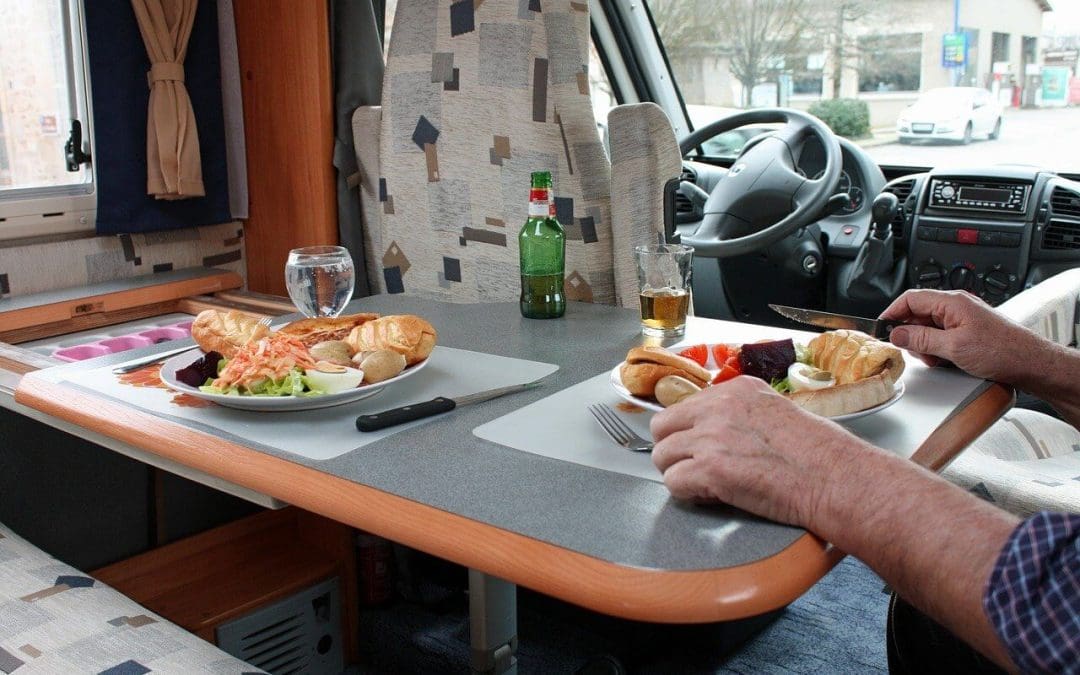
Save money RVing with meal preparation rather than eating at restaurants. The cost differential between a restaurant meal for two and a prepared meal in the RV is significant, and it repeats at every meal across every day of the trip. This doesn’t require elaborate cooking: simple batch-prepared proteins, one-pot meals, and make-ahead components that require minimal assembly at the campsite produce significant per-meal savings without consuming significant travel time. Preventive maintenance protects against the large, unplanned expenses that derail travel budgets. Tire pressure checked before every significant drive, wheel bearing inspection and repacking on schedule, roof and seal inspection before the travel season, and generator maintenance on the manufacturer’s recommended interval are the habits that prevent the roadside failures and campsite repairs that cost multiples of what the preventive service would have.
Frequently Asked Questions (FAQs)
What is the most effective single way to save money RVing?
Membership campground programs combined with public lands camping are the single most effective money-saving strategy. Campsite fees represent one of the highest recurring costs, and membership programs can reduce or eliminate that cost for a flat annual fee.
How much can driving slower actually save?
Reducing highway speed from 65 to 55 mph in a typical motorhome can represent 10 to 15 percent better fuel economy, which on a long trip translates to a meaningful dollar amount. The time added by driving slower is modest on long travel days, and the fuel savings compound across a travel season into a significant annual number that most RV travelers underestimate until they calculate it.
Is boondocking difficult for new RVers trying to save money RVing?
Boondocking has a learning curve but is more accessible than most new RVers expect. The primary skills are managing battery capacity, water consumption, and tank capacity. A quality battery bank with solar charging, conservative water habits, and a tank monitoring system are the investments that make extended off-grid stays comfortable. Most experienced boondockers describe their first few trips as the steepest part of the curve and subsequent trips as genuinely preferred over hookup camping.
How does cooking in the RV help save money?
The per-meal cost differential between a prepared RV meal and a restaurant meal for two is typically $15 to $40 or more, a difference that multiplies across three meals a day and weeks of travel into a budget impact most travelers underestimate. Batch-cooked proteins, one-pot meals, and make-ahead components that require minimal campsite assembly are the meal strategies that work best without consuming significant travel time.
Does preventive maintenance really save money in the long run?
Yes, dramatically. A tire blowout, a wheel bearing failure, a roof leak, or a generator failure all cost multiples of the preventive service that would have prevented them. The maintenance principle is straightforward: the cost of a service appointment is almost always lower than the failure it prevents, and roadside failures include towing, campsite changes, and trip disruption on top of the repair cost itself.
Blue Ribbon RV Inspection offers RV inspections throughout Arizona. Contact us to schedule an appointment today.